|
||
| DAVID K. GREER
Litigation Attorney |
||
|
|
||
|
Case Updates 10-to-Life No More After the Chancey Roberson case, attorney David K. Greer candidly concedes that sometimes it's best that a client not follow the attorney's advice. Roberson, David's client, was facing a mandatory minimum of ten years to life in a cocaine conspiracy superseding indictment in U.S. District Court for the Southern District of Ohio, Eastern Division, in Columbus. One estimate had Roberson serving a minimum term of over 12 years under the advisory Sentencing Guidelines. And the government had several co-conspirator witnesses against Roberson. Nevertheless, to his credit Assistant United States Attorney David Bosley called a meeting to discuss a possible plea agreement with Roberson. Terms of 36 months with self-surrender to a minimum security prison were discussed, subject to the court's approval. Given the risks of trial, and the substantial prison term reduction offered by the government, attorney Greer repeatedly recommended that Roberson take the plea deal. David even took the unprecedented step of putting his recommendation on the record at a hearing before U.S. District Judge George C. Smith. Roberson, however, citing his faith in attorney Greer's abilities, refused.
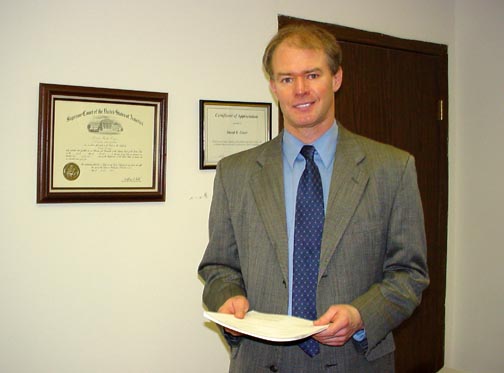
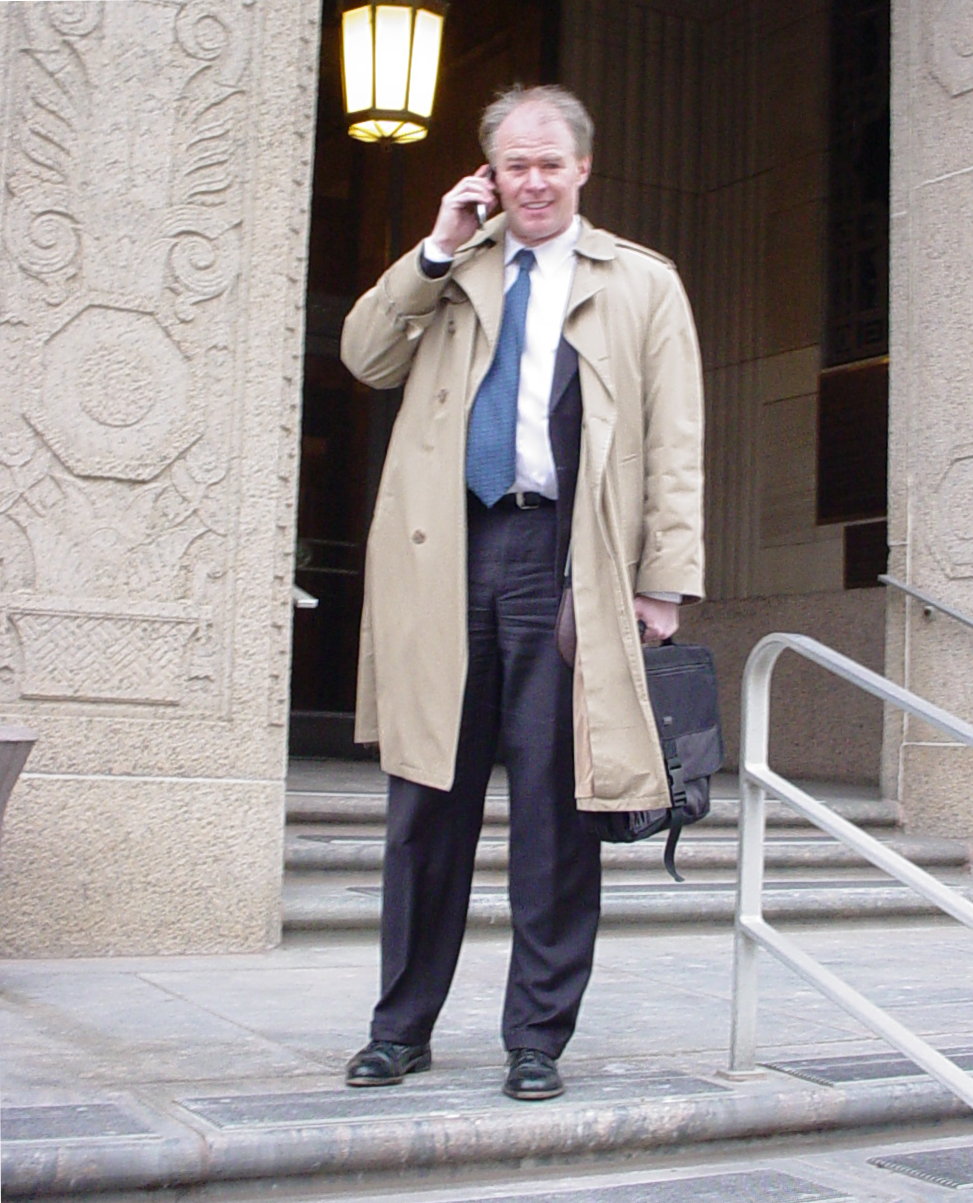
A gleeful attorney David Greer on the steps of the federal courthouse after the district court declared a mistrial following the jury's 11-1 vote in favor of acquittal. (Photo courtesy of Stephanie Ludwig) A majority of the jury felt that way too, unable to conclude that the government had proven its case beyond a reasonable doubt. After three days of deliberating, the jury foreperson handed a note to Judge Smith's bailiff that the jury was hopelessly deadlocked. It was later determined that the vote was 11-1 in favor of acquittal. Given the near acquittal, the government reconsidered its position. Instead of insisting on a plea to conspiracy, the government offered to file a bill of information for one count of maintaining a place for the use, storage or distribution of a controlled substance, in violation of 21 U.S.C. §856(a)(2). In addition, the government offered not to oppose probation for Roberson. Roberson accepted these generous terms and pled guilty to the bill of information on November 13, 2006. At his sentencing on March 21, 2007, it was no more 10-to-life indeed! Judge Smith sentenced Roberson to a three-year term of supervised release (i.e., probation), with credit for local jail time previously served, and a $100 special assessment. Roberson and attorney Greer were very pleased with the outcome. Although now somewhat embarrassed by his earlier advice for Roberson to take a plea in exchange for a 36-month sentence, David says he will continue to advise clients to take a plea bargain if the case warrants it. Still, he acknowledges, "this case speaks volumes that no attorney has a crystal ball as to what a jury will do."
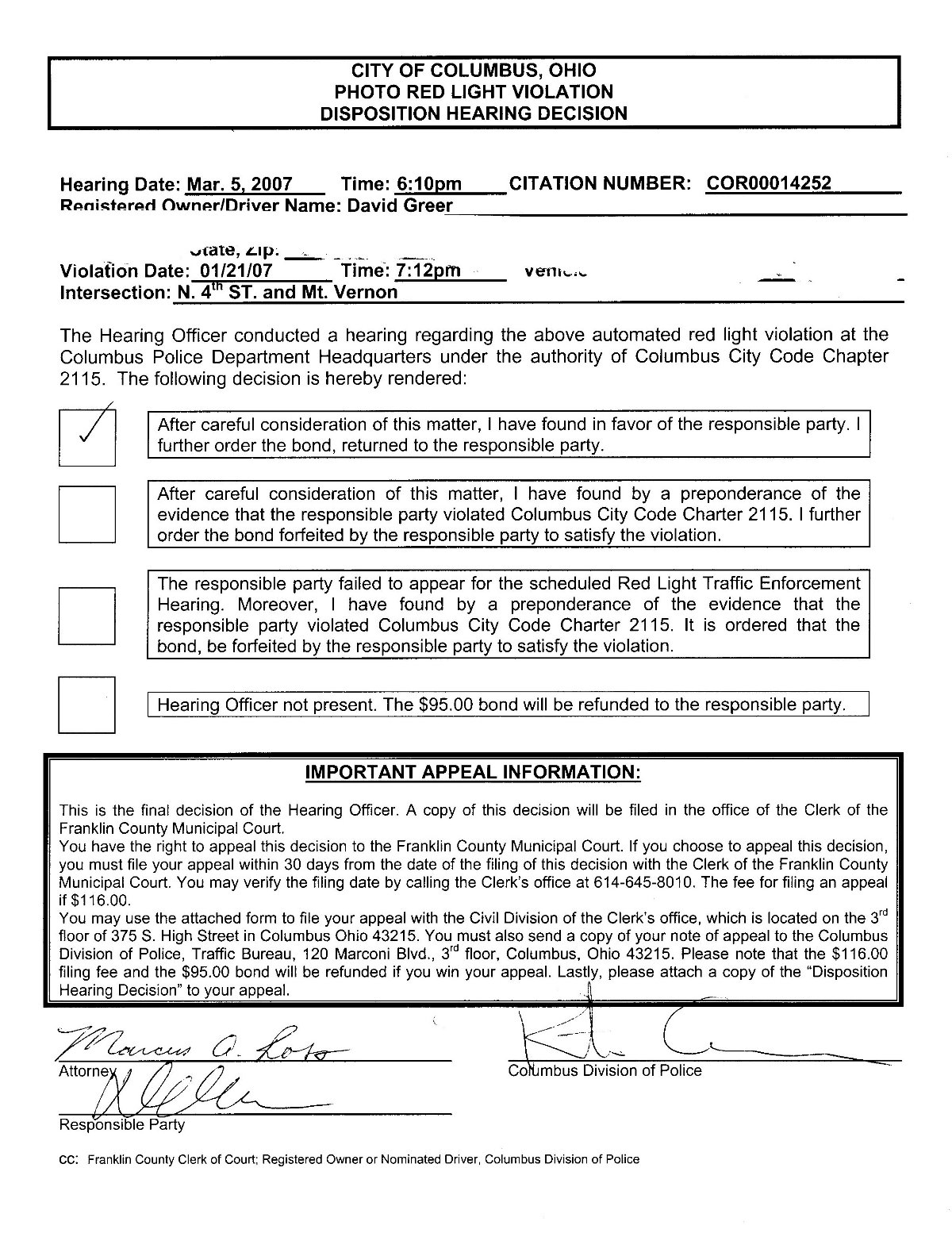
DAVID REPRESENTS HIMSELF Red Light Photo Enforcement: Is it Constitutional? As the adage goes, he who represents himself has a fool for a client. That is, unless the client is attorney David K. Greer! On January 29, 2007, David received in the mail a "Notice of Liability" for an alleged red light violation from eight days earlier, which demanded a $95 payment. David was startled to receive a ticket from over a week before, but fortunately he remembered the incident. That was the night of Columbus' first major snowstorm, and the city had done a mediocre job, at best, of clearing the city streets. The streets were icy and snow-covered. At the intersection of N. 4th Street and Nationwide Blvd., David was faced with a split-second critical decision whether to proceed through the yellow light, or hard braking and risk having a serious accident. He naturally chose the former. As it turned out, the car he was driving that night, a 2004 Chevy Cavalier, was at the legal stop line on the roadway as the light turned red, so arguably David didn't run the red light to begin with. According to the photo red light's speed measuring sensor device, his Cavalier was travelling 37 mph. David mailed in the required $95 payment and demanded a hearing. Unlike a regular traffic citation, in which the motorist is presumed innocent, Columbus, Ohio is one of the few places in the civilized world where a $95 payment (called a "bond", but a payment nonetheless) is required in order to get a hearing. As he mailed in the payment, David thought to himself that he was lucky he wasn't a single mom with five kids wondering if he would be able to make the rent, let alone $95 for a hearing to prove his innocence. David prepared for the hearing by writing the City of Columbus Transportation Division and asking for a public record printout of the timing of the yellow light sequence at that particular intersection. Sure enough, it was a quick yellow, only 3.6 seconds long. A yellow light that quick would be a trap for the unwary under ideal conditions, let alone under the treacherous street conditions David encountered.
"After careful consideration of this matter, I have found in favor of [attorney David K. Greer]. I further order the bond returned to [him]", the hearing officer ruled on March 5, 2007. The hearing was held at the Columbus police station of all places, the evening of March 5, 2007. Although it was intimidating to have to fight a ticket at the headquarters of the very police agency that issued the ticket, David felt he was courteously treated. Officer Rita Green escorted David to the hearing, which was held on the third floor of the police station. The video of the alleged infraction was played. It was so close, so ticky-tack, that the hearing officer had to replay the video two or three times. There were also still shots of the episode. Representing himself, David explained the circumstances and contended that he was not guilty of running the light. The hearing officer came to a quick verdict, concluding that David was driving in a reasonable and safe manner and found in his favor, and ordered a return of David's $95. The entire hearing took literally five minutes from the moment David walked in the door. He was relieved his innocence was proven on video. The video aspect is clearly the best part of the photo red light enforcement system. Although David believes he was treated fairly at the adjudicatory stage, he feels the ticket should not have been issued to begin with. The head of the Columbus Focus on Safey program, as it is called, in response to criticism about the program wrote to the Dispatch newspaper and said he instructs his officers to issue a ticket only if they would have otherwise issued one had the officer been present, but this is not what is happening, if David's case is any indication. "I'm lucky I wasn't from, say, Cleveland, with no practical ability to drive back to Columbus to contest the ticket", David said afterward. Regarding the process itself, David asserts there are serious constitutional issues involved, not the least of which is requiring the motorist to pay $95 in advance, by a certain deadline of less than a month, just to get a hearing. He or she may not have the $95 to lend to the city while waiting on a hearing. Another problem is forcing the registered owner of the vehicle to defend himself when he or she may not have been driving. There is an affidavit for the owner to swear to if he or she reported the vehicle stolen, under penalties of perjury, but if the vehicle was not reported stolen, yet the owner does not know who was driving, he or she is forced to pay the $95 and defend him or herself in "red light court". Another problem is the driver having to remember an incident from a week to two weeks ago in order to prepare a defense. With a traditional traffic citation, the driver can make mental notes of such things as road conditions, obstructions, etc., at the scene, and generally be more observant about possible defenses while it is fresh on his or her mind. Another due process issue is that the notices of liability are only mailed via regular mail. If the driver has moved, if the envelope was incorrectly addressed, or if it was simply lost in the mail, the registered owner will have lost his or her right to a hearing and, further, the city will assess a $25 late fee. The owner will never have an opportunity to contest the alleged violation. Lastly, although the hearing officer treated David fairly in this case, there is the problem of having to pay an additional $116 just to get to real court, if the owner loses at the police station hearing. David contends the motorist should have the right to an automatic new trial in municipal court with no upfront court costs, similar to a trial de novo from mayor's court. A Victory for the Constitution Attorney David K. Greer considers it a victory not so much for himself, as for the Constitution. On September 30, 2004 a unanimous Franklin County Court of Appeals reversed an order imposing over $1,300.00 in restitution on Ramon Bell, on the grounds that the restitution order violated double jeopardy. The appeals court remanded the case to Common Pleas Judge Dale Crawford, who had issued the restitution order, with instructions to vacate the order. Judge Lisa Sadler authored the 8-page appeals court decision. The double jeopardy ruling rendered moot attorney Greer's other argument in the appeal. David had also argued that the restitution order was invalid because there had been no factual connection between the conduct for which Bell was convicted, attempted unauthorized use of a motor vehicle, and the damage to the vehicle which had been the basis for the restitution claim.
Two fast things: David's car, and his victory in the court of appeals in the Ramon Bell case. The appeal, which had been placed on the accelerated calendar, was decided just seven weeks after oral argument. David praised Judge Sadler's opinion, which was joined by the other two judges on the panel, Judges Charles Petree and Cynthia Lazarus. "Judge Sadler does not have a reputation as a friend of the criminal defense bar, not by any means. However, the judge realized that this case had constitutional ramifications, and constitutional rights obviously affect us all." Attorney Greer not only praised the reversal, but the appeals court's reasoning as well. "The appeals court correctly determined that, whatever Judge Crawford's intentions, a court speaks only through its journal entries, and therefore jeopardy attached when the court issued its original sentencing entry, which was nine days before the judge's 'Supplemental Entry' imposing over $1,300.00 in restitution." The state did not appeal the appeals court ruling.
Not Guilty Verdict in Price Five-Count Rape Indictment In March 2004, attorney David Greer won a not guilty verdict for his client Jeff Price in a five-count rape indictment. The indictment stemmed from allegations several years ago involving a four-year old child with whom Price was once acquainted. Price's mother-in-law once cared for the child while in the custody of children services. Attorney Greer, in consultation with his client, decided to waive a jury trial and elected to be tried by Judge Patrick McGrath of the Franklin County Common Pleas Court. The tactical gamble paid off. On March 29, 2004, Judge McGrath delivered his verdict of not guilty on all counts, making Price a free man.
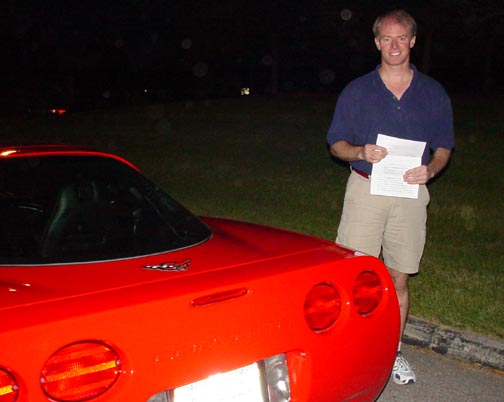
David Greer with one of the legal briefs he reviewed in his successful defense of Jeff Price. Price had been indicted for rape. Rape may sound terrible, but "this charge was bogus", David commented after the acquittal.
David called both the mother-in-law and Price's wife as witnesses at the trial, who both testified that they observed nothing unusual in the rare interactions Price had with the child. Price himself also testified, and denied that any improprieties had taken place between him and the child. In fact, Price testified that the child was actually friendly with him during a chance encounterat an auto store in 2000. Based on this evidence, Judge McGrath concluded that the prosecution failed to prove its case. After the verdict, David praised the judge, and even the prosecutor, Jeff Rogers. "I felt Jeff presented the case fairly, gave me adequate discovery, and did a good job with what he had to work with", David commented. As for Judge McGrath, David understood the difficult position he was in and had nothing but praise and respect for his demeanor on the bench. "It's not easy being a judge trying a rape case, let alone in an election year. The eyes of the public are on you." (Judge McGrath since won the election and now sits on the court of appeals.) "But a judge must be fair and impartial, regardless of the public clamor one way or the other. Any criminal case must be proven beyond a reasonable doubt, and clearly, this case was not proven. So Judge McGrath did the right thing and found my client not guilty."
The content of this Web site is for general information purposes only. It does not constitute legal advice or the substitute for an attorney-client relationship. Contacting David K. Greer at this e-mail address does not establish an attorney-client relationship. Any use of this Web site is for personal use only. All other uses are prohibited. © 2011 Law Office of David K. Greer. All rights reserved. |
|||||||||||||||||||













 So
against attorney Greer's advice, the case proceeded to a jury trial
on October 31, 2006. As promised, the government called several
co-defendant witnesses who claimed that Roberson was part of the
conspiracy. David's succint cross-examination of each of the
witnesses brought out the fact
that the government had offered to file a motion to reduce their sentences from
the advisory Guideline range in exchange for their cooperation. This
cooperation meant testifying against Roberson, the only defendant
in the alleged conspiracy who elected to go to trial. David's concise 10-minute
closing argument reiterated this point. "These men are
desperate", David argued to the jury.
So
against attorney Greer's advice, the case proceeded to a jury trial
on October 31, 2006. As promised, the government called several
co-defendant witnesses who claimed that Roberson was part of the
conspiracy. David's succint cross-examination of each of the
witnesses brought out the fact
that the government had offered to file a motion to reduce their sentences from
the advisory Guideline range in exchange for their cooperation. This
cooperation meant testifying against Roberson, the only defendant
in the alleged conspiracy who elected to go to trial. David's concise 10-minute
closing argument reiterated this point. "These men are
desperate", David argued to the jury.